EN 10305-4 is the European standard for seamless cold drawn steel tubes for hydraulic and pneumatic power systems. It is not a separate product from EN 10305-1 – it takes the same tube and adds the two things a pressure circuit needs: proven pressure integrity and a bore clean enough that a seal and a valve will survive it.
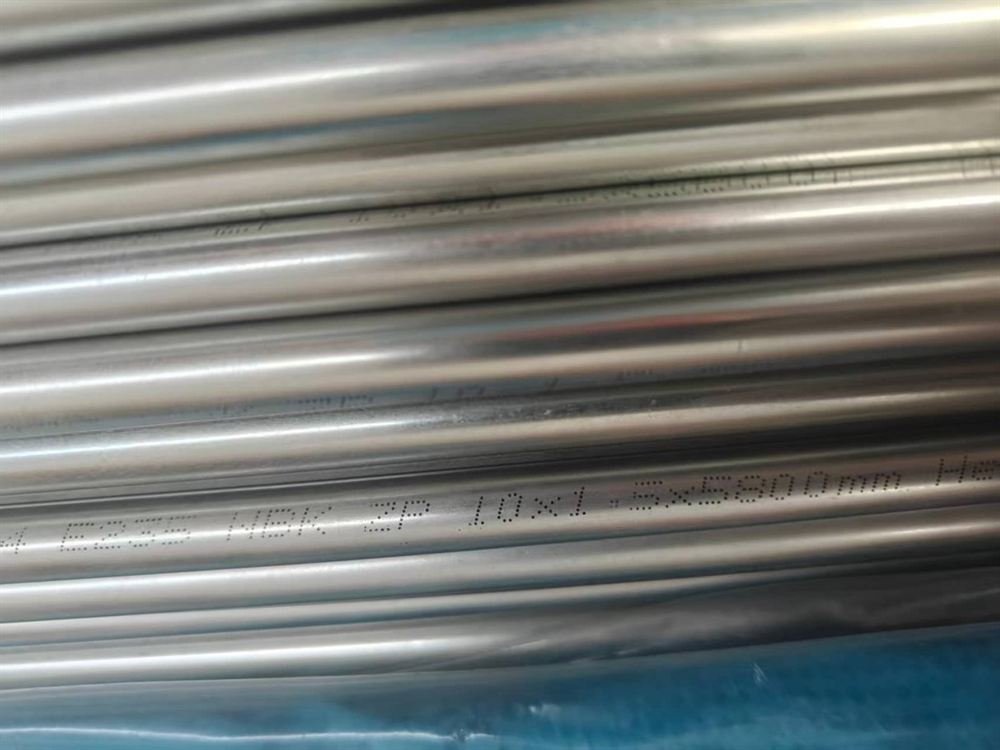
Why the -4 part exists
A general precision tube to EN 10305-1 may be dimensionally perfect and still be wrong for a hydraulic line. It can carry scale or drawing lubricant in the bore, it has no routine pressure test, and its surface defects are judged against a mechanical-tube acceptance level. In a 200 bar circuit those three things become leaks, worn seals and contaminated oil.
EN 10305-4 closes each of them:
- Pressure integrity – routine non-destructive testing of the tube body, plus a hydrostatic test when called out.
- Bore condition – a defined internal surface, free of scale and harmful residue, delivered oiled and with capped ends.
- Traceability – heat identification on the bundle and a certificate that names the standard and the delivery condition.
Where -4 sits in the EN 10305 family
| Part | Construction | For |
|---|---|---|
| EN 10305-1 | Seamless, cold drawn | General precision mechanical tube |
| EN 10305-2 | Welded, cold drawn | General precision, welded route |
| EN 10305-3 | Welded, cold sized | Precision tube from strip, sized after welding |
| EN 10305-4 | Seamless, cold drawn | Hydraulic and pneumatic power systems |
The welded equivalents of -4 exist for lower pressure circuits, but once the line is safety related – steering, brakes, lifting – the seamless route is the one that is normally specified, and it is the one we hold stock of.
Steel grades and chemistry
| Grade | C % max | Si % max | Mn % max | P % max | S % max | Al % min |
|---|---|---|---|---|---|---|
| E235 | 0.17 | 0.35 | 1.20 | 0.025 | 0.025 | 0.015 |
| E355 | 0.22 | 0.55 | 1.60 | 0.025 | 0.025 | 0.015 |
E235 is the general hydraulic grade and bends and flares readily. E355 is chosen when the wall has to carry more pressure at the same diameter, or when the part is machined thin. Both are aluminium killed fine grain steels, which is what makes the low temperature toughness predictable.
Delivery conditions – the suffix that changes everything
The letter after the grade is not decoration. It tells the mill how to finish the tube, and it decides whether the part can be formed after delivery.
| Condition | Meaning | Use it when |
|---|---|---|
| +C | Cold drawn, no heat treatment | Highest strength, best machinability; not for bending or flaring |
| +LC | Light annealed | Compromise between strength and formability |
| +SR | Stress relieved after drawing | Machined parts that must stay straight and crack-free |
| +A | Annealed | Parts that are bent, flared or swaged after delivery |
| +N | Normalised | Hydraulic lines, welded assemblies, uniform structure |
Most hydraulic cylinder and line tube ships +N or +SR. If your drawing says +C and your process bends the tube, the tube will crack and the certificate will still be correct – that is a specification error on the drawing, not a quality defect.
Mechanical properties
| Grade & condition | Tensile Rm | Yield ReH | Elongation A |
|---|---|---|---|
| E235 +C | ≥ 480 MPa | ≥ 350 MPa | ≥ 8 % |
| E235 +SR | 430–580 MPa | ≥ 300 MPa | ≥ 14 % |
| E235 +N | 380–480 MPa | ≥ 235 MPa | ≥ 25 % |
| E355 +C | ≥ 550 MPa | ≥ 450 MPa | ≥ 5 % |
| E355 +SR | 500–650 MPa | ≥ 400 MPa | ≥ 10 % |
| E355 +N | 450–600 MPa | ≥ 355 MPa | ≥ 20 % |
Typical values from certificates for cold drawn seamless tube; the standard tabulates them by condition and diameter, and thin wall samples give different elongation. Read the lot certificate for the numbers that apply to your delivery.
Tolerances you can expect
| Item | Typical band | Comment |
|---|---|---|
| Outside diameter | ±0.08 mm on small sizes, wider on large | Tolerance class must be stated; the default is not the tightest |
| Wall thickness | ±10 % nominal | Tighter available on mandrel-drawn lots |
| Inside diameter | H9 / H10 achievable on request | For cylinder shells the ID is the functional dimension |
| Straightness | 0.5–1.0 mm per metre | State 0.5 mm/m if the tube feeds a bar machine |
| Eccentricity | Within 10 % of wall | The figure that decides whether a honed bore cleans up |
Testing and documentation
- Non-destructive test of the tube body – eddy current is the normal method, run over the full length.
- Hydrostatic test – when the order calls for it; test pressure is agreed, not implied.
- Tensile test per lot, reported as Rm, ReH and elongation.
- Dimensional and visual inspection – OD, wall, length, straightness, surface.
- Certificate – EN 10204 3.1 naming EN 10305-4, the grade and the condition. A 3.1 with only “E235” and no condition is not a complete certificate.
Preservation for export
Seamless hydraulic tube is delivered with the bore oiled and the ends capped. That is not cosmetic: an unoiled bore in a sea container flash-rusts, and rust in a hydraulic circuit destroys pumps. If your process requires a dry degreased bore, say so at enquiry – we will pack to that requirement rather than assume.
How to write it on a purchase order
EN 10305-4, E355, +N, 40 mm OD × 4 mm wall, tolerance class as agreed, eddy current tested, bore oiled and capped, 3.1 certificate, length 6 m. The three fields people forget are the condition, the tolerance class and the test – and each one is a separate line on the mill’s price.
Applications
- Hydraulic cylinder barrels, before honing
- Piston rod and tie rod tube
- Power steering and steering gear lines
- Suspension and shock absorber components
- Pneumatic cylinders and air line systems
- Lift, excavator and agricultural hydraulic circuits
Frequently asked questions
What is the difference between EN 10305-4 and EN 10305-1?
-1 is the general precision tube standard. -4 starts from the same tube and adds hydraulic requirements: routine non-destructive testing, a defined bore condition, oiled and capped delivery, and a certificate that names the condition. A -1 tube can be perfectly good and still not be a -4 tube.
Can you supply zinc plated hydraulic tube?
Yes, and we supply it to the same base standard. Plating adds a hydrogen embrittlement risk on high strength wall, so the process route matters – tell us the environment and we will advise whether zinc plating, phosphating or an oiled bore is the better answer.
Which condition should I order for a cylinder barrel?
+N or +SR in most cases. +C gives the best machinability but will crack if the tube is subsequently formed. If the barrel is only machined and honed, +C is workable and cheaper; if it is also welded or bent, order +N.
Do you hold stock of E355 +N?
We hold common hydraulic sizes and draw the rest to order. Send the size list with the condition and we will tell you what is on the floor and what needs a drawing run.
Request a quotation: send your size list or drawing through our contact page. We reply within one working day with price, tolerance and lead time.