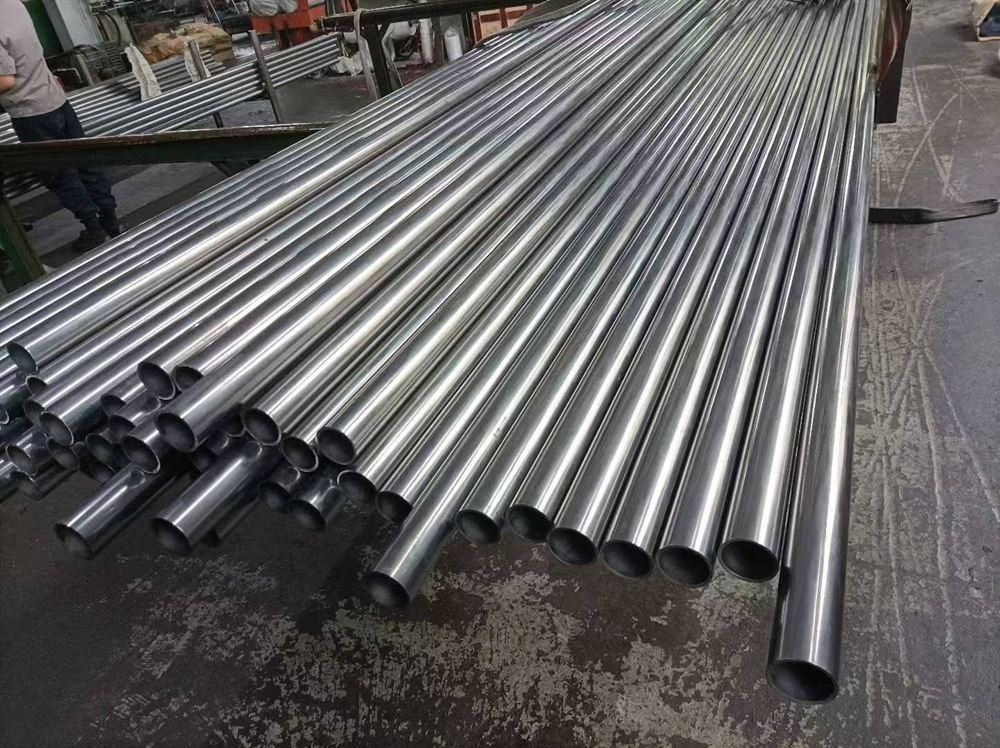
A motorcycle fork tube is the steel inner tube that slides inside the lower leg. It carries the front wheel load, holds the oil, and its outer surface is the sliding surface for the seal, so it has to be straight, round and concentric before it is chrome plated. We supply it cold drawn seamless or DOM, in 20#, 45#, 4130, STKM13A/13C or E355, from 22 mm to 48 mm outside diameter, cut to your length and ready for grinding and hard chrome.
Most enquiries we receive are not for “a fork tube” but for a specific leg: 27 mm, 30 mm, 33 mm, 35 mm, 37 mm, 41 mm or 43 mm outside diameter, wall 1.5-2.5 mm, length 400-800 mm. Send the drawing and we quote against it.
Price: quoted per specification. Steel prices move with the raw material market, so every quotation is confirmed at the time of order.
What the part has to do
A fork tube looks like a simple piece of tube until it is in a fork. Four properties decide whether it works:
- Straightness. A stanchion that is out by 0.3 mm over 500 mm binds in the lower leg and wears the seal on one side. Fork tube is normally straightened to 0.3-0.5 mm per metre and checked on a surface plate.
- Wall concentricity. The tube is ground and then chrome plated. If the wall is eccentric, the chrome layer is thinner on one side and the tube fails there first.
- Surface before plating. Grinding removes 0.05-0.1 mm. A drawn surface with deep longitudinal marks forces a deeper grind and a bigger size change.
- Bore condition. The damper rod runs inside. A rough or oval bore wears the rod guide and changes damping.
That is why fork tube is bought to a drawing with a straightness and concentricity limit, not to a generic tube specification.
Sizes and grades we quote most
| Outside diameter | Typical wall | Process | Typical use |
|---|---|---|---|
| 22-27 mm | 1.2-1.8 mm | Cold drawn seamless | Small displacement forks, rear damper tubes |
| 30-35 mm | 1.5-2.0 mm | Cold drawn seamless or DOM | Commuters, off-road 125-250 cc |
| 37-41 mm | 1.6-2.5 mm | Seamless, DOM, honed bore | Sport and adventure bikes |
| 43-48 mm | 1.8-3.0 mm | Seamless, honed bore | Large displacement, upside-down forks |
Grade choice follows the load and the plating process:
- 20# for standard road forks; cheap, draws well, plates predictably
- 45# where the stanchion also takes a clamp load or a thread
- 4130 chromoly (ASTM A519) for off-road and performance forks: higher strength at the same wall, so the wall can be thinner
- STKM13A / STKM13C (JIS G3445) for Japanese-designed forks
- E355 / St52 where the drawing is European and calls for a weldable high-strength grade
How the tube is made for this part
| Step | What happens | Why it matters to the fork |
|---|---|---|
| Cold drawing | Seamless billet or welded shell is drawn over a mandrel to size | Tight wall and OD tolerance with a smooth drawn surface |
| Stress relief | Controlled anneal after drawing | Stops the tube moving after grinding and plating |
| Straightening | Two-roll straightener, then checked on a plate | 0.3-0.5 mm per metre before machining |
| Honing (on request) | Bore honed to Ra 0.4-0.8 µm | Clean running surface for the damper rod |
| Cutting | Cut to length, deburred, ends square | Less scrap at the fork assembly line |
| Protection | Oiled, capped, bundled in wooden cases | No transit marks on the surface that will be chrome plated |
Tolerances we hold
| Property | Typical value | Note |
|---|---|---|
| Outside diameter | h9 / h10 | Tighter on request before grinding allowance |
| Wall thickness | plus or minus 5-8 percent | Wall eccentricity controlled for plating |
| Inside diameter | H9-H10, honed on request | For damper rod clearance |
| Straightness | 0.3-0.5 mm per metre | Checked piece by piece |
| Bore roughness | Ra 0.4-0.8 µm honed | Measured and reported |
| Length | plus or minus 1 mm | or as drawing |
We supply the tube before grinding and chrome plating. If you need a finished, chrome plated stanchion, tell us the plating thickness and the grinding allowance and we will quote the tube to that allowance, with plating arranged through our partner line.
Where the same tube is used
Fork tube is one part in a family of tubes with the same requirements: straight, concentric, smooth bore, ready for a sliding surface.
- Rear shock absorber damper tube – see shock absorber tube
- Hydraulic cylinder barrel – see hydraulic cylinder tube
- Steering column and seat post tube – DOM tube to ASTM A513
- Front fork outer tube in steel – welded precision tube to DIN 2393 / EN 10305-2
Buying fork tube from China: what to check
Fork tube is one of the few parts where a small mill difference shows up months later, in the seal and in the chrome. When comparing offers, ask for these four documents with the sample, not after the order:
- A dimensional report on the actual pieces, including wall eccentricity, not only OD and wall
- A straightness record taken on a surface plate over the full length
- The steel grade certificate with the heat number, so the grade can be traced
- The surface roughness report if the bore is honed
A supplier who can send those four with a two-metre sample is a supplier worth a trial order. A supplier who sends only a price is a risk to your plating line.
Ordering
Send the drawing or these six values and we will quote within one working day:
- Outside diameter and wall (or the tube drawing number)
- Grade, or the standard if the grade is fixed by it
- Length and cut tolerance
- Bore condition: as drawn or honed
- Grinding allowance, if you grind in-house
- Quantity and destination port
Frequently asked questions
Do you supply finished, chrome plated fork tubes?
We supply the tube before grinding and plating as standard. Chrome plating can be arranged through our partner line if you give the plating thickness and grinding allowance, and the tube is then drawn oversize for that allowance.
Which grade is best for a fork stanchion?
For road forks, 20# drawn tube is the common choice. For off-road or performance forks, 4130 chromoly to ASTM A519 lets you keep the strength with a thinner wall. Japanese drawings usually call for STKM13A or STKM13C to JIS G3445.
What straightness can you hold?
0.3-0.5 mm per metre as standard, checked piece by piece on a surface plate. Tighter limits are possible on short lengths and are agreed per size.
Can you supply small trial quantities?
Yes. A trial lot of a few hundred kilograms in one or two sizes is normal for a first order, so the plating line can run a test before a container is booked.
Do you make the outer fork leg as well?
In steel, yes: welded cold drawn tube to DIN 2393 / EN 10305-2. Aluminium outer legs are outside our range.
How is the tube packed for export?
Oiled, ends capped, bundled with strapping and, for fork tube, packed in wooden cases so the drawn surface arrives without handling marks.