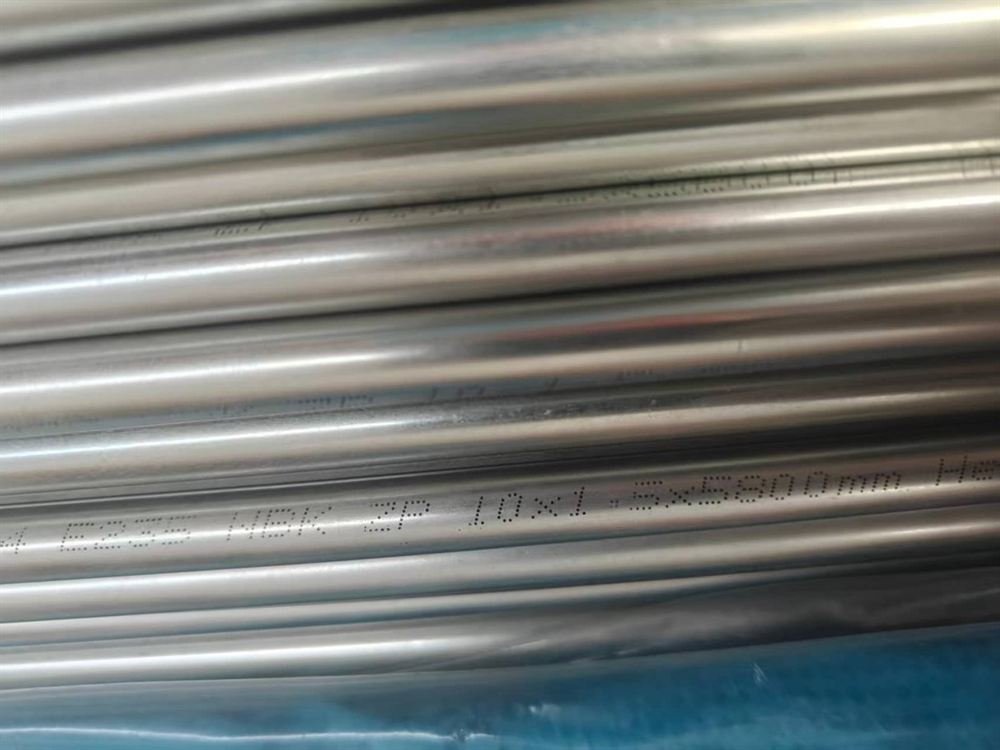
Hydraulic tubing is the steel tube that carries oil at pressure in a hydraulic system: cylinder barrels, pressure and return lines, manifolds, accumulators and the hard lines on mobile equipment. We supply it cold drawn seamless to EN 10305-1 and EN 10305-4, and cold drawn welded to EN 10305-2, in grades E235 and E355 or the older DIN 2391 grades St35, St45 and St52, from 4 mm to 80 mm outside diameter. Tubes can be supplied as drawn, honed to Ra 0.2–0.4 µm for cylinder barrels, or zinc plated and black phosphated for line work.
Price: quoted per specification. Steel prices move with the raw material market, so every quotation is confirmed at the time of order.
Three different tubes are sold under the same name
Buyers ask for “hydraulic tubing” and mean one of three things. Getting the right one first time avoids a lot of scrapped material.
| What it does in the system | What is critical | Typical specification |
|---|---|---|
| Cylinder barrel (the bore the piston runs in) | Bore diameter, roundness, surface roughness | EN 10305-4, honed Ra 0.2–0.4 µm, H8–H9 bore |
| Pressure and return line (hard line between components) | OD and wall, bendability, corrosion protection | EN 10305-1 E235 / E355 as drawn, zinc plated |
| Manifold and accumulator body | Wall thickness, machinability, cleanliness | Thick wall seamless, normalised on request |
If the tube is going to be bent, say so. Bend radius and the bending method decide whether the tube should be supplied annealed, and whether a welded tube is acceptable at all.
Hydraulic pipe or hydraulic tubing?
In hydraulic work the two words are used interchangeably, which causes confusion in enquiries. Strictly, pipe is specified by nominal bore and tube by exact outside diameter, but a hydraulic fitter will call a 12 mm hard line a “pipe” all day. When you write the enquiry, give the dimensions rather than the word: OD × wall, or ID if the bore matters. We will match it to the nearest standard size and tell you if a non-standard size has to be drawn.
Grades and supply condition
| Grade | Standard | Typical use |
|---|---|---|
| E235 | EN 10305-1 / -2 / -4 | General hydraulic lines, cylinder barrels after honing |
| E355 | EN 10305-1 / -4 | Higher strength barrels and lines, thinner wall for the same pressure |
| St35 / St45 / St52 | DIN 2391 | Older drawings still specified in Germany and eastern Europe |
| 20# / 45# | GB/T 3639 | Chinese domestic drawings, common on cylinder barrels |
Supply condition matters as much as the grade. Tubes are delivered as drawn (bright, Ra 0.8–1.6 µm), annealed for bending, honed for barrels, or coated. Zinc plating and black phosphating are both stocked as finishes on the line-tube sizes; if the parts will be painted, phosphated tube takes paint better than plated tube.
What to put on the enquiry
- Size: OD × wall, or ID × wall if the bore is the controlled dimension.
- Grade and standard: E235, E355, St52, or the drawing number.
- Condition: as drawn, annealed, honed, zinc plated, phosphated.
- Length: fixed length with tolerance, or random length for cutting in your own shop.
- End use: barrel, line, manifold. It decides the tolerance we work to.
Where these tubes end up
Forklift masts and tail lifts, agricultural loaders, workshop presses, injection moulding machines, mining equipment, truck hydraulic kits and small power packs. Most of these customers buy a mixture: a honed barrel size, two or three line sizes, and a short cut length for a specific fitting. Mixed containers are normal for us.
FAQ
Can you supply tubing already cut and deburred? Yes. Cut length, squareness and chamfer are quoted with the tube; deburring is done in-house.
Is welded tube acceptable for hydraulic lines? For low-pressure return lines, often yes, and EN 10305-2 is written for exactly that. For pressure lines above roughly 100 bar we normally recommend seamless, and for barrels we always do.
What is the difference between EN 10305-1 and EN 10305-4? -1 is the general cold drawn seamless standard. -4 is written for hydraulic and pneumatic power systems and tightens the bore, cleanliness and test requirements, which is why barrels are bought to -4.
Do you supply in small quantities? Trial orders and mixed sizes are normal. Tell us the sizes and we will quote them together.