JIS G3445 is the Japanese standard for carbon steel tubes for machine structural purposes. It is the number Japanese and Southeast Asian buyers write for motorcycle frames and fork parts, shock absorber bodies, seat frames, steering columns and general machinery components – a range that in Europe would be split between EN 10305-1 and EN 10305-2.
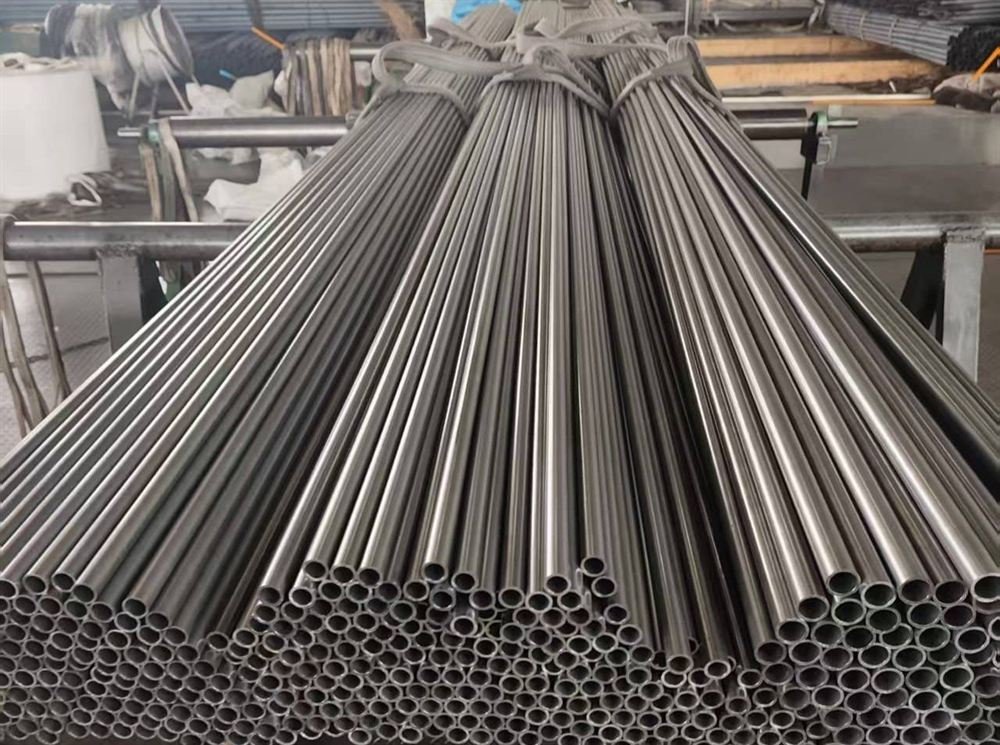
What G3445 covers
The standard covers tubes used to carry load or to be machined into machine parts, in a range of carbon steels designated STKM. It fixes the grade, the mechanical requirements, the dimensional tolerances and the test methods – and, importantly, it allows several manufacturing routes, which is where most of the confusion starts.
The manufacturing route is part of the specification
JIS G3445 does not force one process. Tube to this standard can be seamless, welded and drawn, or welded and used as welded, and the route has to be stated in the order because it changes three things:
- Cost – welded and drawn is the cheapest route that still gives a precise wall; seamless is the most expensive.
- Seam – a welded route leaves a seam, which matters for a part that is bored, honed or pressure loaded.
- Tolerance and surface – drawing tightens both; an as-welded tube is a different product at the same grade.
An enquiry that says only “STKM13A, 25 x 2” will be quoted twice with different prices, and the cheaper one will not be the same tube.
Grades
| Grade | Character | Typical use |
|---|---|---|
| STKM11A | Lowest carbon of the common grades, easiest to bend and weld | Frames, brackets, general structures |
| STKM12A / 12B / 12C | Medium carbon and strength; the letters indicate increasing carbon within the grade | Fork parts, seat rails, machinery components |
| STKM13A / 13B / 13C | Higher strength than the 12 series | Loaded frame sections, shock absorber bodies, steering parts |
| STKM14A and above | Progressively higher carbon and strength, narrower permitted size range | Wearing or highly loaded parts, often after heat treatment |
The standard runs from STKM11A through the STKM20 series, with A, B and C variants where it provides them. The three grades above cover the overwhelming majority of enquiries; if your drawing names a higher number, availability depends on the size and the mill schedule.
One structural point that catches buyers: the higher the grade, the narrower the range of diameter and wall the standard allows. A very thin wall in a high-carbon grade is not a commercial question, it is outside the specification.
Choosing the grade
Grade selection is about the process the part goes through, not only the stress:
- Bent and welded, no heat treatment – STKM11A or 12A. Ductility matters more than strength, because a crack at the bend scraps the part.
- Bent, then loaded in service – STKM12 or 13. The bend radius has to be checked against the grade: higher carbon bends less well.
- Machined, not formed – STKM13 or higher, since formability is no longer the limit.
- Heat treated after delivery – agree the grade and the treatment together; the same grade responds differently depending on the condition it arrives in.
Delivery condition
| Condition | Effect | Choose it when |
|---|---|---|
| As welded | Cheapest, widest tolerance, seam present | Non-critical structures, painted parts |
| Cold drawn | Tight tolerance, smooth surface, higher strength | Machined parts, precise fits |
| Annealed | Maximum ductility | Bending and flaring after delivery |
| Normalised | Uniform structure along the length | Parts needing consistent properties |
Tolerances to agree before the order
| Item | What to specify | Why it matters |
|---|---|---|
| Outside diameter | Nominal and band | Fit and weld fixture location |
| Wall | Nominal and range | Strength of the section, bore after machining |
| Straightness | Deviation per metre | Bending machine feed, welded assembly alignment |
| Length | Fixed, multiple or random | Cutting loss on a long production run |
| Seam | Permitted inner bead height | Parts that are bored or carry flow |
Tests
Tensile strength, yield strength and elongation per lot; flattening and bending tests on the tube; dimensional and visual inspection. Hydrostatic testing and non-destructive testing are available on request rather than as standard. The mill certificate carries the heat number and the measured values – for a Japanese-standard order, ask for the values, not just the grade name on the cover.
Cross-reference
| Standard | Family | Practical relation |
|---|---|---|
| JIS G3445 | Machine structural carbon steel tube | This page |
| EN 10305-1 | Seamless cold drawn precision tube | European equivalent for the seamless route; grades E215–E355 |
| EN 10305-2 | Welded cold drawn precision tube | European equivalent for the welded route |
| ASTM A519 | Seamless mechanical tubing | US equivalent; AISI grades instead of STKM |
| ASTM A513 | Welded mechanical tubing | US welded route; types by drawing method |
STKM11A is often compared with a low carbon grade around 1010, and STKM13 with a medium carbon grade around 1020–1025. These are approximations: substitution needs a check of the mechanical values your drawing requires, not just the carbon level.
How to write JIS G3445 on a purchase order
“Steel tube to JIS G3445, grade STKM13A, seamless cold drawn, 25.4 x 2.0 mm, OD tolerance ±0.10 mm, wall ±10 %, length 5800 mm, straightness 1.5 mm/m, mill certificate with tensile and yield, EN 10204 3.1.”
The manufacturing route and the condition are the two clauses that most often go missing – and the two that decide the price.
Applications
- Motorcycle frames and subframes – STKM11A/12, bent and welded.
- Fork tubes and stanchions – precise OD and straightness, often drawn and ground.
- Shock absorber bodies – thin wall, machined ends.
- Seat rails, stands, brackets – formed parts, no heat treatment.
- General machinery – shafts, sleeves and spacers where a Japanese grade is on the drawing.
Frequently asked questions
What is the difference between STKM11A and STKM13A?
Carbon content and strength: 11A is softer and bends better, 13A is stronger and less forgiving at tight radii. If the part is bent after delivery, the radius decides as much as the strength.
Is JIS G3445 seamless or welded?
Both routes are allowed. The order has to say which one, because the price, the seam and the tolerance all follow from that choice.
Can JIS G3445 replace EN 10305-1?
Often in practice, when size and mechanical requirements line up, but it is a substitution that a designer signs off – not something a supplier should do silently.
Do you supply STKM in small quantities?
From a trial lot upwards, depending on size and grade. Send the size list with the annual volume and we will answer on both.
Request a quotation: send your size list or drawing through our contact page. We reply within one working day with price, tolerance and lead time.