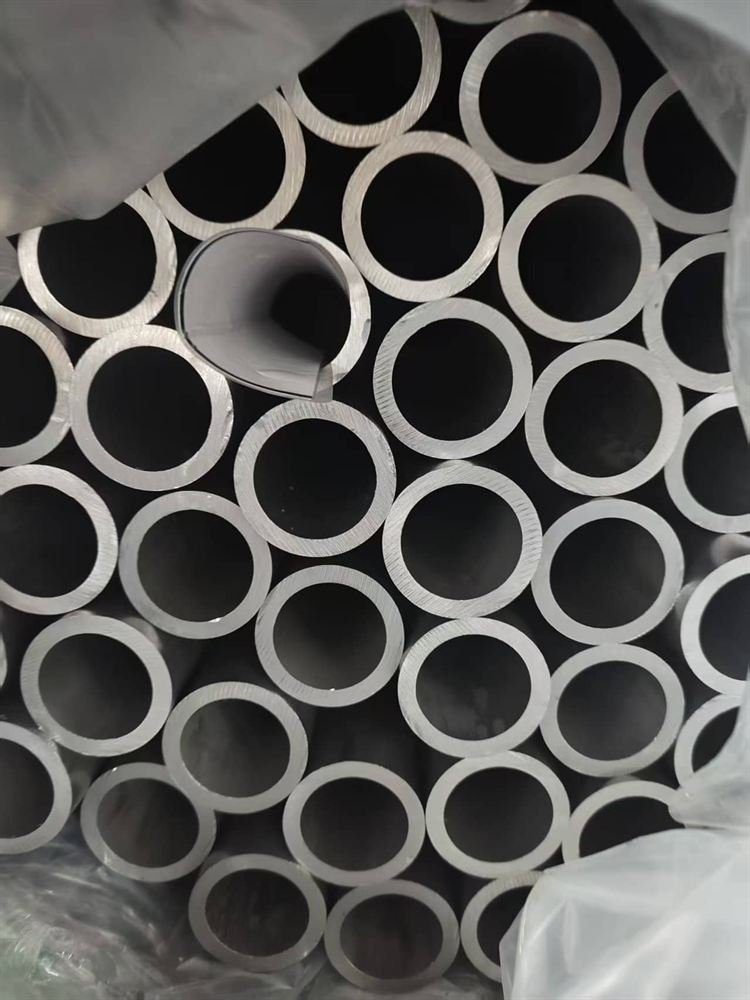
Bushing tube, sleeve tube and collar tube are the same product under three names: a short piece of precision tube, cut to length, used as a bearing surface, a spacer or a wear sleeve. The buying decision is almost always inside diameter, wall and cut length, not the steel grade. We supply it cold drawn seamless to EN 10305-1 / DIN 2391 and cold drawn welded to EN 10305-2, in E235, E355, St35, St45, St52 and 20#, from 8 mm to 80 mm outside diameter, cut, deburred and chamfered to your drawing.
Price: quoted per specification. Steel prices move with the raw material market, so every quotation is confirmed at the time of order.
Bushing, sleeve, collar — what is the difference
| Name | What it does | What is bought |
|---|---|---|
| Bushing | Bearing surface between a shaft and a housing | ID tolerance and bore finish, wall for press fit |
| Sleeve | Wear or repair sleeve over a shaft or inside a bore | OD and ID, wall, length |
| Collar / spacer | Sets a distance or takes a clamp load | Length tolerance and square ends |
In practice the same tube goes into all three, and the difference is in the secondary operation: a bushing is usually reamed after cutting, a sleeve is often ground on the OD, a collar is used as cut.
ID, wall and tolerance
A bushing is judged on its bore. If the tube is bought as drawn and then reamed, a bore tolerance of H9–H10 and Ra 0.8–1.6 µm is enough. If the tube is used as cut, the bore has to be closer to H8 and smoother, and the wall has to be uniform so the press fit does not distort the bore. For thin-wall bushings, wall eccentricity is the number that matters, because a 0.2 mm eccentric wall on a 2 mm wall section collapses unevenly when pressed in.
Cutting, deburring and chamfer
- Cut length tolerance: normally ±0.2 mm; ±0.1 mm on request.
- Squareness: the cut face is square to the axis, which matters when the bushing is pressed against a shoulder.
- Deburring: both ends, inside and outside, as standard on cut parts.
- Chamfer: 0.5 × 45° or to drawing, to help the press fit start square.
Where bushing tube is used
Shock absorber eye bushings, suspension pivot sleeves, hinge bushes, hydraulic cylinder rod-end bushings, agricultural implement pivots and general repair sleeves. Most of these customers order a mixed list of sizes with a short cut length, which is why we quote the whole list rather than one line.
FAQ
Can you supply cut lengths with a chamfer? Yes. Cut, deburr and chamfer are quoted together; the chamfer is normally 0.5 × 45° unless the drawing says otherwise.
Which grade for a bushing? Grade is usually decided by the load, not the bearing surface: E235 for light duty and spacers, E355 or 45# where the sleeve carries load or is welded. If the bore will be reamed and used dry, tell us and we will advise on finish rather than grade.
Can you hold a press-fit OD? Yes, OD is drawn to the tolerance class you specify; for press fits we normally work to the drawing rather than to a catalogue tolerance.
Do you supply short runs? Yes. Mixed sizes and small quantities are normal for bushing work.