DIN 2393 is the German standard for welded precision steel tube: the strip is welded first, then cold drawn, so the seam is smoothed and the wall becomes concentric. It has been superseded by EN 10305-2, but it is still written on a large number of European, Turkish and CIS drawings – and a mill that cannot answer to the old number loses those enquiries.
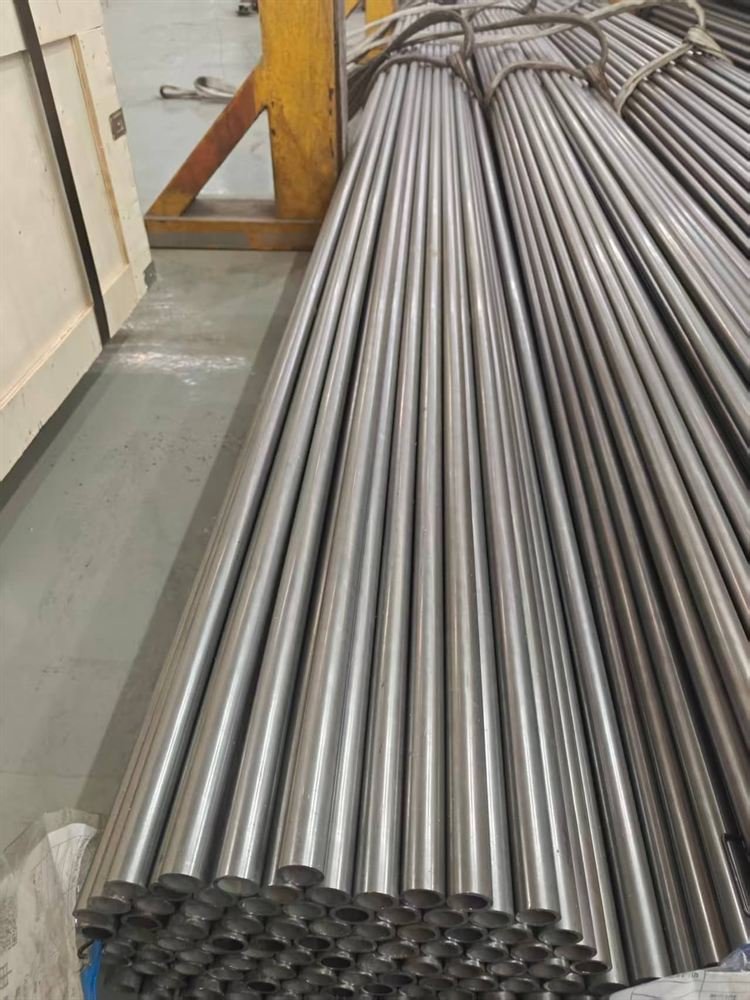
What DIN 2393 covers, and where it stands today
The standard describes welded precision tube made by forming strip into a tube, welding the seam, and drawing the welded tube to the final size. The drawing pass does three things at once: it brings the outside diameter into tolerance, evens out the wall, and flattens the weld bead so the outside is smooth and the inside is usable.
Formally DIN 2393 is withdrawn and replaced by EN 10305-2. In practice we produce to EN 10305-2 and state conformance to DIN 2393 on the same certificate, so a customer holding an old drawing does not have to re-issue it. What changes is the grade naming and the condition symbols, not the product.
Why the old number is still on drawings
- Legacy German and Austrian machinery – drawings from the 1980s and 1990s were never revised.
- Turkish and Eastern European subcontractors – many still quote DIN numbers to their own customers.
- CIS design bureaux – DIN was the reference standard copied into local practice long before EN was adopted.
If your drawing says DIN 2393 and your customer’s inspection sheet says EN 10305-2, one certificate covering both closes the gap.
Grades
| DIN 2393 grade | Character | Typical use | Approximate EN counterpart |
|---|---|---|---|
| St34-2 | Lowest strength, easiest to form | Casings, covers, bent frames | E195 / E215 |
| St37-2 | General purpose, good weldability | Shock absorber bodies, bushes, spacers | E235 |
| St44-2 | Medium strength | Loaded sleeves, brackets | E275 |
| St52-3 | Highest of the four | Parts with thin wall and load | E355 |
The right-hand column is a practical approximation, not an identity: equivalence has to be confirmed against the mechanical values your drawing requires, and against the condition of supply.
Delivery conditions
| Symbol | Condition | Effect |
|---|---|---|
| BK | Cold drawn, hard | Highest strength, lowest ductility; used close to delivered size |
| BKW | Cold drawn, soft | Softer than BK, easier to machine and form |
| BKS | Stress relieved after drawing | Keeps most strength, removes the stress that moves a bored part |
| GBK | Annealed | Maximum ductility for bending and flaring |
| NBK | Normalised | Uniform structure along the length |
BK and GBK are two different products from the same mill line. If a part is bent after delivery, ordering BK and hoping for the best is the most common way to lose a batch.
Welded and drawn against seamless
The welded route starts from strip, so it uses less material and less drawing effort than a pierced billet. That is why DIN 2393 tube is cheaper than DIN 2391 at the same size. The trade-off is the seam: after drawing it is smoothed, not metallurgically removed.
Consequences worth knowing before you specify it:
- For machining, bushes, spacers, casings and frames, the seam is irrelevant – the tube behaves like a uniform wall.
- For a honed or SRB bore, the seam is cut away by the machining allowance, and the part is fine.
- For a pressure vessel or a hydraulic barrel working at high pressure, the seam has to be assessed by the designer. Where the drawing forbids a seam, the answer is DIN 2391 / EN 10305-1, not DIN 2393.
Tolerances to agree before the order
| Item | What to specify | Why |
|---|---|---|
| Outside diameter | Nominal and tolerance band | Fits, collet grip, coating thickness allowance |
| Wall | Nominal and permitted range | Bore after machining |
| Concentricity | Maximum wall variation | Whether the bore cleans up on both sides |
| Straightness | Deviation per metre | Feeding into automatics |
| Length | Fixed or random with minimum | Cutting loss |
| Seam | Whether the inner bead must be smooth, and to what depth | The one requirement the standard leaves loose |
Testing and documents
Chemistry per heat, tensile and elongation per lot, flattening, dimensional check, and a visual check of the seam. On request: hydrostatic test, eddy current testing, coating mass if the tube is galvanised, and an EN 10204 3.1 certificate. Marking can carry both DIN 2393 and EN 10305-2, and documents for Russia and the CIS can be issued in Russian.
Cross-reference
| Standard | Construction | Relation to DIN 2393 |
|---|---|---|
| EN 10305-2 | Welded, cold drawn | Current replacement |
| DIN 2393 | Welded, cold drawn | This page |
| DIN 2391 | Seamless, cold drawn | Same family, no seam, higher cost |
| ASTM A513 Type 2 | Welded, mandrel drawn | US equivalent in practice |
How to write DIN 2393 on a purchase order
“Welded precision steel tube to DIN 2393 / EN 10305-2, grade St37-2, condition GBK (annealed), 25.0 x 1.5 mm, OD tolerance ±0.10 mm, wall ±10 %, length 3000 mm, inner bead smoothed, mill certificate 3.1.”
Applications
- Shock absorber bodies – the classic DIN 2393 part: thin wall, machined ends, welded cap.
- Bushes and spacers – cut and machined, no seam issue.
- Furniture and frame parts – bent and welded, GBK condition.
- Casings and covers – St34-2, formed and painted.
Frequently asked questions
What is the difference between DIN 2393 and EN 10305-2?
The old German specification and the current European one. Both describe welded cold drawn precision tube; the grade names and condition symbols differ. We certify to both on request.
Can DIN 2393 be used for a hydraulic cylinder?
For low pressure cylinders and where the bore is machined past the seam, sometimes yes. For a pressure-loaded barrel the drawing should call for seamless tube – that is a design decision, not a purchasing one.
Is the weld visible after drawing?
Outside, practically not. Inside, a shallow trace remains and its depth is agreed in the order.
Can it be supplied galvanised?
Yes; see the galvanised precision tube range. Note that a hot dip coating adds thickness and must be allowed for in the tolerance.
Request a quotation: send your size list or drawing through our contact page. We reply within one working day with price, tolerance and lead time.