SAE J524 is the American specification for seamless low carbon steel tubing, annealed for bending and flaring. It exists for one reason: the tube has to be formed by the person who installs it. A line that is bent round a chassis leg and then flared onto a fitting must not crack at the bend or split at the flare, which is why the standard fixes the annealed condition and the forming tests rather than a single strength figure.
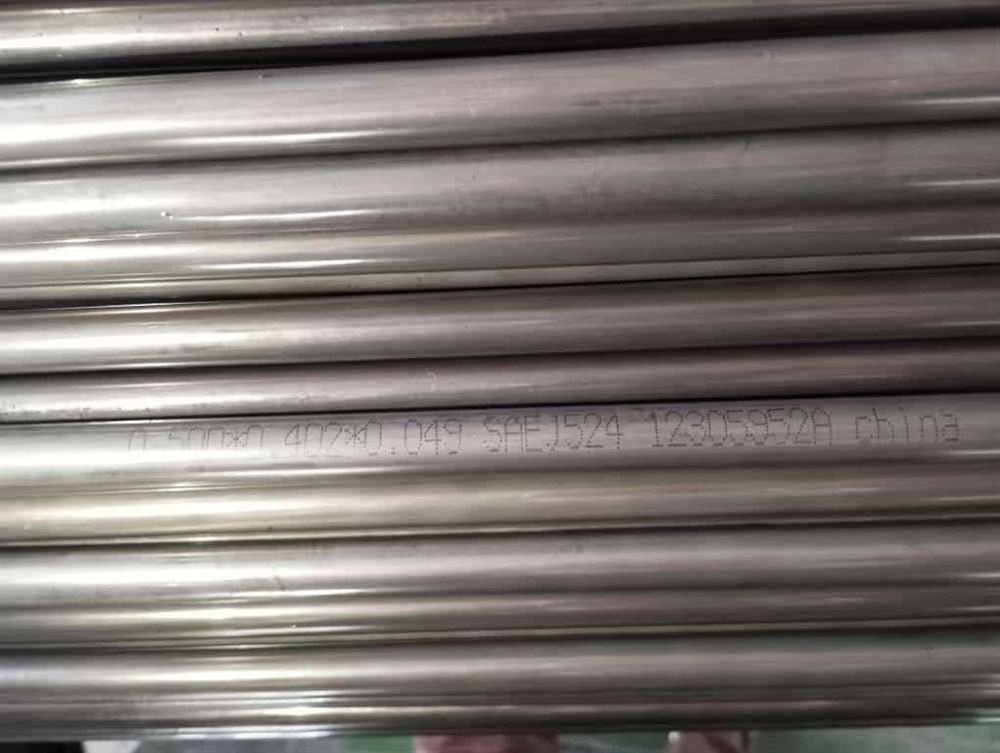
What J524 actually controls
Three things, and they are the three that fail in service:
- Seamlessness. There is no weld to open up when the tube is expanded by a flaring tool or fatigued by vibration. J524 is seamless only – the welded version is a different document, SAE J525.
- The annealed condition. Hard drawn tube is stronger but brittle at the flare. J524 tube is annealed so the metal flows instead of tearing.
- Forming tests. Flaring and bending are verification tests, not optional extras: they prove the lot will survive what the installer does to it.
What J524 does not do is set a working pressure for your assembly. Pressure capability comes from the OD and wall you choose, the fitting, and the bend radius – calculate it for the actual line, do not assume the standard covers it.
J524 against the specifications it is confused with
| Specification | Construction | Condition | Typical use |
|---|---|---|---|
| SAE J524 | Seamless, cold drawn | Annealed | Hydraulic, fuel and brake lines that are bent and flared on installation |
| SAE J525 | Electric resistance welded, cold drawn | Annealed | Same duties where a weld is acceptable and cost matters |
| ASTM A254 | Welded, copper brazed | As brazed | Refrigeration and low pressure service |
| EN 10305-4 | Seamless, cold drawn | +N or +C | European hydraulic power systems – a different document with its own test regime |
| DIN 2391 | Seamless, cold drawn | BK, BKW, BKS, GBK | German precision tube, superseded in Europe by EN 10305-1 |
J524 and J525 are often quoted interchangeably by buyers, and they are not the same tube. If the drawing says J524 and the mill ships J525, the certificate will not match the drawing even though the tube may work.
Chemistry
Low carbon, fully killed, no alloying additions. The exact heat analysis is on the mill certificate; these are the ranges we normally see.
| Element | Typical range | Why it matters |
|---|---|---|
| C | 0.06–0.15 % | Above this the flare edge work-hardens and tears |
| Mn | 0.30–0.60 % | Strength and deoxidation |
| Si | ≤ 0.10 % | Kept low for formability |
| P | ≤ 0.035 % | Segregation embrittles the bend |
| S | ≤ 0.035 % | Same, plus surface quality |
Mechanical properties in the annealed condition
| Property | Typical requirement | Comment |
|---|---|---|
| Tensile strength Rm | ≥ 310 MPa | Lower than hard drawn tube – that is deliberate |
| Yield strength ReH | ≥ 170 MPa | Design the line on this, not on Rm |
| Elongation A | ≥ 30 % | The number that predicts whether the flare survives |
| Hardness | ≤ 65 HRB typical | Hardness creeping up means the anneal was incomplete |
Values shift with OD and wall: thin wall small diameter tube is tested from a different sample geometry. Treat the table as the floor, and read the actual lot certificate.
Forming limits worth knowing before you design
- Bend radius. Centreline radius of about 3× OD is comfortable in the annealed condition; below 2× OD you need a mandrel bender and a trial bend.
- Flare. 37° single or double flare as the fitting requires. The tube end must be cut square and deburred – a burr is what starts the split.
- Cold working. Every bend work-hardens the metal locally. A line with several tight bends and then a flare at the end is harder than the same line with one bend, even though the certificate is identical.
- Vibration. Annealed tube is soft; support it every 300–400 mm on a vehicle line or it fatigue-cracks at the fitting.
Dimensions and tolerances
| Item | Typical value |
|---|---|
| Outside diameter | ±0.08 mm on small sizes, ±0.10 mm above 12 mm |
| Wall thickness | ±10 % of nominal |
| Concentricity | Wall variation within 10 % – critical where the tube is flared |
| Inside surface | Clean, free of scale and drawing lubricant residue; normally oiled and end-capped for export |
| Length | Random 4–6 m, or cut to length with square, deburred ends |
How to write J524 on a purchase order
SAE J524, seamless low carbon steel, annealed, 9.52 mm OD × 0.71 mm wall, oiled and capped, random 4–6 m, 3.1 certificate with flaring test. Adding the flaring test line is what makes the certificate useful to your customer – without it you have chemistry and a tensile result but no proof the tube flares.
Applications
- Brake lines and clutch lines on vehicles and trailers
- Fuel lines and return lines
- Power steering and hydraulic return lines
- Lubrication and grease lines on machinery
- Air and instrumentation lines where a weld is not wanted
Frequently asked questions
What is the difference between SAE J524 and SAE J525?
J524 is seamless, J525 is welded. Both are low carbon and both are annealed for bending and flaring. J524 is chosen where a weld seam is unacceptable – typically brake and high-integrity hydraulic lines; J525 is cheaper and fine for many return and low pressure duties.
Can J524 tube be used for a pressure line?
It can, but the standard alone does not rate the line. Working pressure comes from OD, wall, fitting and bend radius. Tell us the working pressure and the fluid and we will confirm which wall holds it, rather than quoting a size that happens to be on the shelf.
Do you supply J524 and J525 from the same mill?
We source both, but from lines that hold the relevant approval. Ask for the certificate in the enquiry – if the drawing says J524, the certificate must say J524.
Why does the tube arrive oiled and capped?
Annealed low carbon steel flash-rusts in a sea container. The bore is oiled and the ends capped at packing, which is normal for export and expected on a hydraulic line. Say if your process needs a dry, degreased bore instead.
Request a quotation: send your size list or drawing through our contact page. We reply within one working day with price, tolerance and lead time.