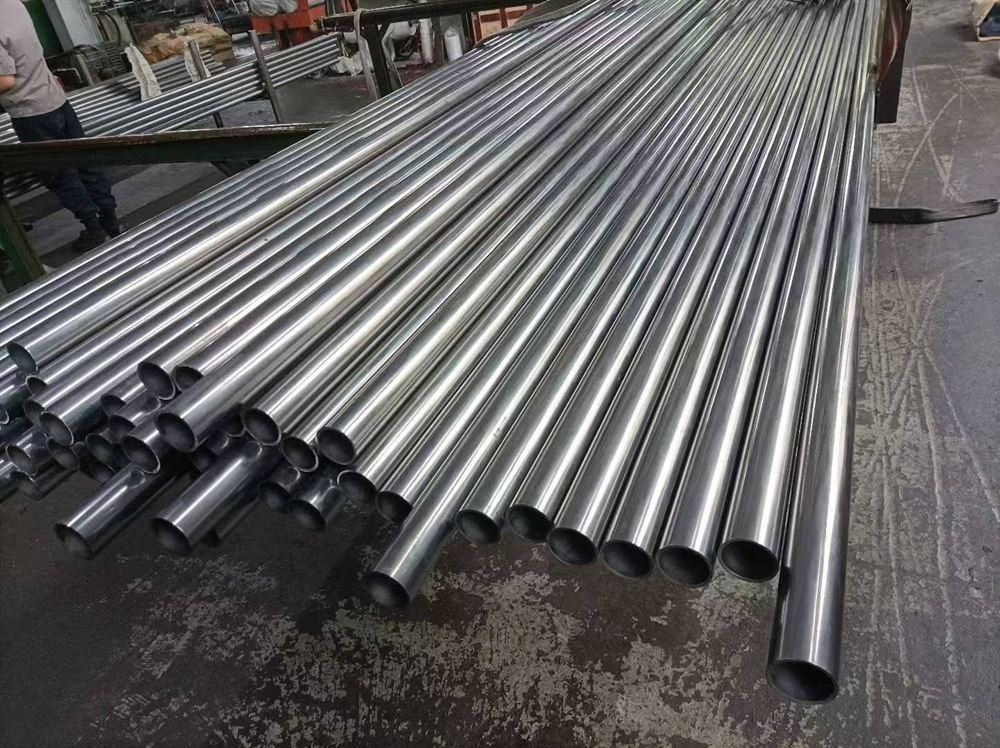
A shock absorber needs two different tubes. The outer reservoir tube is welded and carries the oil; the inner pressure tube guides the piston and is judged on its bore. We supply both: welded cold drawn tube to EN 10305-2 / DIN 2393 / SAE J525 in E235C, and seamless precision tube to EN 10305-1 / DIN 2391 in E235, E355 or St52, as drawn or honed to Ra 0.2-0.4 µm.
Sizes run from 25 mm to 60 mm outside diameter with 1.0-3.0 mm wall, cut to length and deburred for the welding or rolling line.
Price: quoted per specification. Steel prices move with the raw material market, so every quotation is confirmed at the time of order.
Twin-tube and mono-tube use different tubes
| Damper type | Tube | Process and standard | What decides the quality |
|---|---|---|---|
| Twin-tube | Reservoir (outer) tube | ERW welded, cold drawn, annealed – EN 10305-2 E235C, DIN 2393, SAE J525 | Weld quality, ovality after drawing, surface for the foot valve seat |
| Twin-tube | Pressure (inner) tube | Seamless cold drawn – EN 10305-1 E235/E355, DIN 2391 St35/St52 | Bore tolerance and roughness, wall concentricity |
| Mono-tube | Pressure tube with gas chamber | Seamless, honed – EN 10305-1, honed Ra 0.2-0.4 µm | Bore finish under pressure, straightness, end finish for the seal head |
| Either | Piston rod | Chrome plated bar or thick-wall tube | Chrome adhesion and straightness |
On a welded reservoir tube the seam is the risk. It is drawn after welding, so the weld is reduced and stress relieved; the tube is then tested by flattening and, for damper work, by an internal pressure test. A reservoir tube that passes dimensions but fails flattening will split at the seam on the first high-pressure stroke.
Sizes and grades
| Outside diameter | Wall | Grade | Typical use |
|---|---|---|---|
| 25-32 mm | 1.0-1.5 mm | E235C, SAE 1010 | Motorcycle rear dampers, small car dampers |
| 33-45 mm | 1.2-2.0 mm | E235C, E235, St35 | Passenger car twin-tube dampers |
| 45-52 mm | 1.5-2.5 mm | E355, St52, 20# | Mono-tube dampers, off-road suspension |
| 52-60 mm | 2.0-3.0 mm | E355, 45# | Heavy dampers, industrial shock absorbers |
Chinese drawings usually call 20# or 45# where the European drawing calls E235 or E355. Both routes are available; the certificate follows the standard named on the order.
What we control in production
- Weld seam. In-line edge trimming before welding, then drawing over a mandrel to reduce the bead and close the seam.
- Wall uniformity. Draw passes are set so the wall stays within plus or minus 5-8 percent; an uneven wall changes the damper oil volume and the strength at the seam.
- Ovality. Checked after straightening, because an oval reservoir tube will not seal against the end cap.
- Bore finish. Honed on request for pressure tubes, with the roughness measured and reported, not judged by eye.
- Cut and end condition. Square cut, deburred, no burr left inside the tube where it would score the piston.
Tolerances
| Property | Welded reservoir tube | Seamless pressure tube |
|---|---|---|
| Outside diameter | h10, or as drawing | h9 / h10 |
| Wall | plus or minus 8 percent | plus or minus 5-8 percent |
| Inside diameter | as drawn | H9-H10, honed on request |
| Straightness | 0.5 mm per metre | 0.3-0.5 mm per metre |
| Bore roughness | not specified | Ra 0.2-0.4 µm honed |
Documents and tests
Each lot ships with a chemical and mechanical certificate, a dimensional report and a flattening result on welded tube. On request we add an internal pressure test, an eddy current test on the weld, or a salt spray report for galvanized tube. EN 10204 3.1 certificates are issued when the order asks for them.
Where the same tube goes
- Motorcycle fork tube – the front suspension counterpart of this page
- Hydraulic cylinder tube – the same bore requirements at larger diameter
- DIN 2393 / EN 10305-2 welded precision tube
- Galvanized precision tube – for dampers that see road salt
Frequently asked questions
Which tube is used for the outer body of a shock absorber?
Twin-tube dampers normally use welded cold drawn tube to EN 10305-2 (E235C) or SAE J525, because the outer body is a welded assembly. Mono-tube dampers use a seamless tube, often honed, because the same tube is the pressure chamber.
Can you supply honed pressure tube?
Yes, honed to Ra 0.2-0.4 micrometre with an H9-H10 bore, and supplied with a roughness report. Honed tube is packed in wooden cases with the bore protected.
Do you test the weld?
Welded tube is flattening tested as standard and can be eddy current tested on request. An internal pressure test is available for damper bodies when the working pressure is specified.
What length can you cut?
Cut to any length within the drawn bar length, typically up to 6 m, with plus or minus 1 mm as standard. Damper body lengths are usually short, so nesting is not a problem.
Can the tube be supplied for a salt spray requirement?
Yes. Galvanized or zinc plated tube can be supplied with a salt spray report; the coating type and thickness are agreed before the order because they change the drawing size.