DIN 2391 is the German standard for seamless precision steel tubes, cold drawn. It was withdrawn when EN 10305-1 replaced it, but European drawings, machine builders and older Russian and Turkish licences still write DIN 2391 – and a mill that cannot supply to it loses those enquiries. This page is the reference: what the standard actually contains, which steels it allows, and what the certificates are supposed to prove.
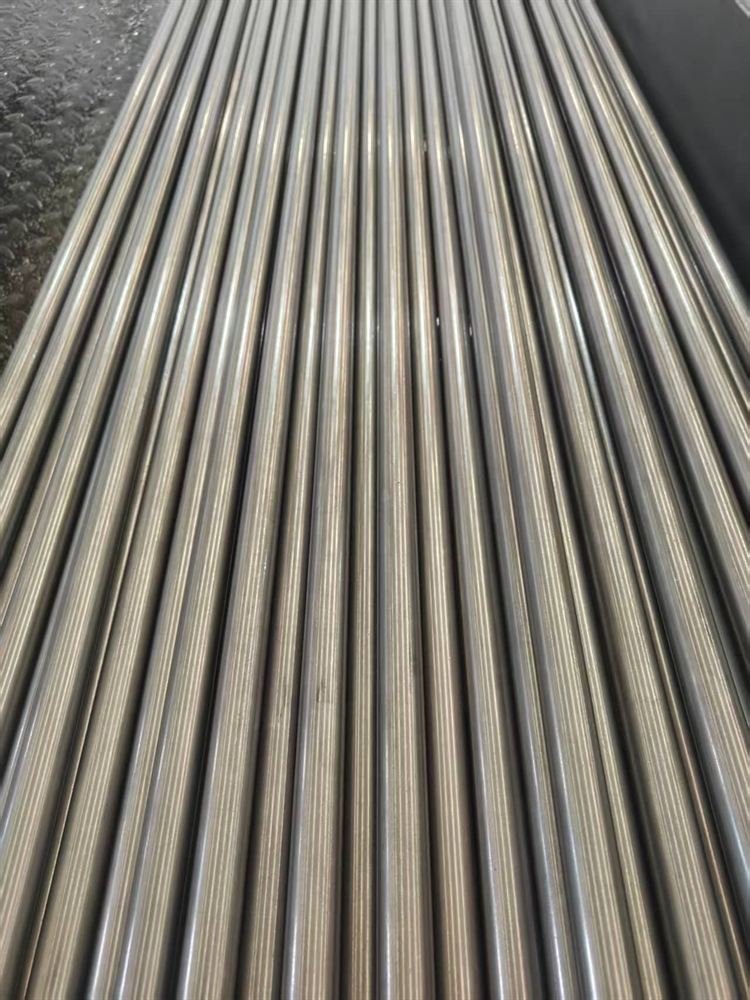
DIN 2391 is two documents, not one
This is the detail that catches people out. The number everyone quotes covers two separate parts, and a drawing that cites only “DIN 2391” is technically incomplete.
| Part | Title | What it fixes |
|---|---|---|
| DIN 2391-1 | Seamless precision steel tubes – dimensions | Outside diameter and wall series, tolerances, length, straightness, ovality, tolerance classes |
| DIN 2391-2 | Seamless precision steel tubes – technical delivery conditions | Steels St35 / St45 / St52, delivery conditions BK, BKW, BKS, GBK, NBK, mechanical properties, test methods, marking |
EN 10305-1 merged the two into a single document, which is one of the practical reasons the European replacement is easier to order against: dimensions and quality can no longer be quoted from different editions.
Steels and chemistry
DIN 2391-2 allows three steels. They are plain carbon, aluminium killed, and they map onto the modern EN grades almost one for one.
| Steel | C % max | Si % max | Mn % max | P % max | S % max | EN equivalent |
|---|---|---|---|---|---|---|
| St35 | 0.17 | 0.35 | 0.40 | 0.025 | 0.025 | E235 |
| St45 | 0.21 | 0.35 | 0.40 | 0.025 | 0.025 | E255 |
| St52 | 0.22 | 0.55 | 1.60 | 0.025 | 0.025 | E355 |
St35 is the bending and flaring grade. St45 is the middle option that appears on older drawings where the designer wanted a bit more strength without going to St52. St52 carries the manganese and is the grade behind most hydraulic cylinder barrels – it is also the one people most often confuse with a chrome-moly steel, which it is not: St52 is a plain carbon-manganese steel and hardens poorly.
Mechanical properties by delivery condition
The delivery condition matters more than the steel. The same St52 coil can leave the mill at 580 MPa in BK or at 480 MPa in GBK, and the drawing only tells you which if it names the condition.
| Condition | St35 | St45 | St52 | Ductility |
|---|---|---|---|---|
| BK – cold drawn, hard | ≥ 480 MPa | ≥ 520 MPa | ≥ 580 MPa | Low – do not bend or flare |
| BKW – cold drawn, soft annealed | 400–520 MPa | 440–560 MPa | 500–640 MPa | Good – forming grade |
| BKS – cold drawn, stress relieved | 430–560 MPa | 470–600 MPa | 540–700 MPa | Moderate – keeps strength, stays straight |
| GBK – annealed, straightened, drawn | 380–480 MPa | 420–520 MPa | 480–600 MPa | Good – machined parts |
| NBK – normalised | 380–480 MPa | 420–520 MPa | 480–600 MPa | Good – parts that get welded |
Tensile ranges as normally reported on DIN 2391-2 certificates for cold drawn seamless tube; yield and elongation are tabulated by condition and diameter in the standard and differ for thin wall. Always read the lot certificate – two mills can both be correct and still differ at the top of a range.
Tolerances in DIN 2391-1
| Item | Typical band for 4–80 mm OD | What drives it |
|---|---|---|
| Outside diameter | ±0.05 to ±0.10 mm | The final draw pass and the die wear allowance |
| Wall thickness | ±10 % of nominal | Plug or mandrel size; tighter only on a controlled lot |
| Inside diameter | Governed by the mandrel, not tabulated as a tolerance class | For cylinder work the bore is the functional dimension |
| Straightness | 0.5–1.0 mm per metre | Straightening after the last draw |
| Ovality | Within the OD tolerance | Checked at the tube ends |
| Length | Random 4–7 m, or fixed with deburred ends | Order line item, not a standard default |
What changed when DIN 2391 became EN 10305-1
The replacement was not a rename. Four things moved, and knowing them explains most of the arguments between a buyer holding an old drawing and a mill quoting to the current standard.
- Grades were renamed. St35 became E235, St45 became E255, St52 became E355. The chemistry barely moved; the labels did.
- Conditions became suffixes. BK became +C, BKW became +LC, BKS became +SR, GBK and NBK became +A and +N.
- Two documents became one. Dimensions and technical delivery conditions are now in a single text, so there is no longer an edition mismatch risk.
- Test and documentation rules were formalised. Non-destructive testing and the inspection document are now called out in the standard rather than agreed case by case.
A DIN 2391 certificate issued today is normally a dual certificate: the tube is made to EN 10305-1 and the certificate states the DIN 2391 grade and condition alongside it. That is legitimate and it is what most European mills do. What is not legitimate is a certificate that says “DIN 2391” with no condition and no edition.
Grade cross-reference
| DIN 2391 | EN 10305-1 | Nearest ASTM | Caution |
|---|---|---|---|
| St35 | E235 | 1010 / 1020 | Carbon range overlaps; manganese and deoxidation practice differ |
| St45 | E255 | 1020 / 1026 | No exact ASTM grade; treat as a family, not a substitution |
| St52 | E355 | 1026 (nearest by carbon) | St52 is not a chrome-moly steel despite the strength |
These are starting points for a conversation, not substitution rights. If a customer’s inspector is comparing certificates, the standard named on the drawing is the one that has to appear on the certificate.
DIN 2391 against the neighbouring standards
| Standard | Construction | Relationship to DIN 2391 |
|---|---|---|
| EN 10305-1 | Seamless cold drawn | Direct replacement, current edition |
| DIN 2393 / EN 10305-2 | Welded cold drawn | Same precision idea, welded route – cheaper, has a seam |
| EN 10305-4 | Seamless cold drawn | Hydraulic version: same tube plus pressure testing and bore cleanliness |
| ASTM A519 | Seamless mechanical | American family, different grade list and certificate language |
| GOST 8734-75 | Seamless cold deformed | Russian assortment standard, paired with GOST 8733-74 for quality |
How to write it on a purchase order
Seamless precision steel tube DIN 2391-1 / DIN 2391-2, steel St52, condition GBK, 40 mm OD × 4 mm wall, OD tolerance ±0.08 mm, straightness 0.8 mm/m, length 6 m fixed, certificate 3.1 with chemical and tensile results. Naming both parts, the condition and the tolerance band removes every degree of freedom the mill would otherwise price against.
Applications
- Hydraulic and pneumatic lines on European machinery
- Cylinder barrels before honing, usually St52 GBK or BK
- Machined bushes, pins and shafts
- Steering and suspension parts on older vehicle platforms
- Replacement parts for German and Italian equipment where the drawing is fixed
Frequently asked questions
Is DIN 2391 still valid, or must I quote EN 10305-1?
The DIN standard is withdrawn but it is not dead: if the drawing says DIN 2391, the tube has to be certified to DIN 2391, and a mill quoting only EN 10305-1 is answering a different question. We supply dual-certified tube so both readings are satisfied.
What is the difference between DIN 2391 and DIN 2393?
2391 is seamless, 2393 is welded and cold drawn. Both are precision tube and both are now covered by EN 10305 parts 1 and 2 respectively. The price gap is real, and so is the seam: 2393 is fine for a bush, 2391 is what you want when the wall carries pressure.
Can you supply St52 in the BK condition for a cylinder barrel?
Yes, and it is a common request because BK machines well and holds a good surface. Check the honing allowance first – BK has low ductility, so a barrel that needs a deep hone to clean up is better ordered GBK.
Do you keep DIN 2391 tube in stock?
Common sizes in St35 and St52, yes. The rest is drawn to order from 4 mm to 80 mm OD. Send the size list with the condition and we will separate what is on the floor from what needs a drawing run.
Request a quotation: send your size list or drawing through our contact page. We reply within one working day with price, tolerance and lead time.