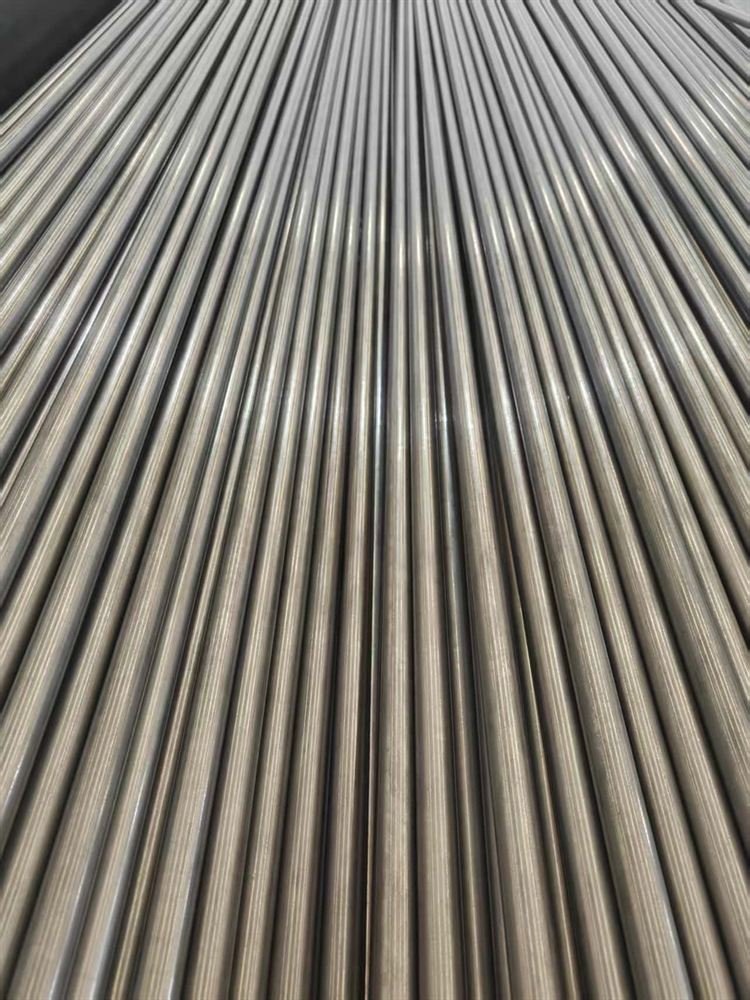
SAE J525 is the American specification for welded and cold drawn low carbon steel tubing, annealed for bending and flaring. It is the welded companion to SAE J524 and exists for one reason: the tube has to be formed by the person who installs it. A line bent round a chassis leg and then flared onto a fitting must not crack at the bend or split at the flare – so the standard fixes the annealed condition and the forming tests, not a single strength figure.
What J525 covers, and what it does not
J525 covers welded tubing that is cold drawn after welding and then annealed. Typical service is low pressure fluid lines: brake lines, fuel and return lines, power steering, transmission cooler lines, and refrigeration or heating circuits. Wall thicknesses are thin, diameters small, and the tube is usually supplied straight in short lengths or in coils.
What the standard does not fix matters just as much when you write an enquiry:
- Pressure rating. J525 does not assign a working pressure. The system designer calculates it from diameter, wall and material; we can supply the burst or proof test data, but the rating is not in the standard.
- Corrosion protection. Coating is not specified. Tubes normally ship with anti-rust oil; phosphating, zinc plating or a coating inside the bore is a separate agreement.
- Cleanliness limits. The standard does not set a particle count. For ABS or injector circuits, write the cleanliness requirement into the order – a general J525 tube will not meet it by default.
J525 against J524: which one to specify
| Item | SAE J524 | SAE J525 |
|---|---|---|
| Construction | Seamless, cold drawn | Welded, then cold drawn |
| Weld seam | None | Drawn down and smoothed, not removed |
| State of supply | Annealed for bending and flaring | Annealed for bending and flaring |
| Relative cost | Higher | Lower |
| Where it wins | Seam not accepted, thin wall in short lengths, highest confidence in the wall | Long coils without joints, thin walls, volume lines where cost matters |
| Typical service | Brake and fuel lines | Brake, fuel, return, cooler and low pressure circuits |
The practical rule: for a hydraulic brake line on a road vehicle, both are in use, and the choice belongs to the system designer. Where a drawing says J524 we do not substitute J525 silently – we quote J524.
Chemistry and grades
J525 does not use AISI grade numbers. It specifies a low carbon steel with limits on carbon, manganese, phosphorus and sulphur, and leaves the deoxidation practice to the mill. In production we supply chemistry in the 1008–1010 range, which is what the forming tests are tuned to. If your process needs a specific carbon range – for example because the part is subsequently brazed or welded – state the range, not just “low carbon”.
Why the annealed condition carries the standard
Cold drawing is what gives the tube its tolerance and surface, and it is also what makes it hard. A hard tube flares badly: the cone opens, the edge splits, and the leak appears only after the fitting is torqued. Annealing after drawing restores elongation, and the flare and bend tests in the specification are the proof that it worked. Two consequences for buyers:
- Do not ask for “hard drawn, then bent”. If the part is formed after delivery, the annealed condition is the one to order.
- If the tube is annealed twice – once at the mill and again after a coating step – check that the second anneal does not soften the tube below the drawing requirement.
The tests the standard relies on
| Test | What it proves | When it matters |
|---|---|---|
| Tensile and yield | The tube is within the strength band for the annealed condition | Always; values on the mill certificate |
| Elongation | There is enough ductility left for forming | Always |
| Flattening | The wall does not crack when crushed between platens | Thin walls, parts that are clamped or crimped |
| Flaring | The tube end opens to a cone without splitting | Any flared fitting joint |
| Bending | The tube takes a bend of the agreed radius without cracking | Lines formed on installation |
| Hydrostatic (optional) | No leak at the agreed test pressure | Safety circuits, customer specification |
The standard sets the tests; the acceptance values depend on diameter, wall and condition. That is why a J525 certificate without the actual measured values is not much use – ask for the numbers, not just the word “pass”.
Tolerances to agree before the order
| Item | What to put in the order | Why it matters |
|---|---|---|
| Outside diameter | Nominal plus tolerance band, e.g. ±0.08 mm | The fitting grip depends on it; a loose tube pulls out under pressure |
| Wall | Nominal and permitted range, often ±10 % | Wall is the pressure-carrying section; the low side governs |
| Ovality | Maximum difference between max and min diameter | Oval tube leaks at the flare |
| Straightness | Camber per metre, or “in coils” | Straight lengths that bow will not feed into a bending machine |
| Length | Fixed, multiple, or coil weight | Cutting losses and handling cost |
| Ends | Deburred, capped, or chamfered | Burrs damage seals and scratch the bore of the next tube |
Inspection and documents
Each lot ships with a mill certificate carrying the heat number, chemistry, tensile and elongation results and the dimensional check. On request we add the flaring and bending records, a hydrostatic test report, eddy current testing, and an EN 10204 3.1 certificate. For Russian and CIS customers the marking and the packing list can be issued in Russian.
Cross-reference to the standards you will meet
| Standard | Construction | Closest match |
|---|---|---|
| SAE J525 | Welded, cold drawn, annealed | This page |
| SAE J524 | Seamless, annealed | Same duty, no seam |
| EN 10305-2 (E235C) | Welded, cold drawn | European equivalent; conditions +C to +N instead of “annealed” |
| DIN 2393 (St37-2) | Welded, cold drawn | Withdrawn German standard, still on old drawings |
How to write J525 on a purchase order
A complete line reads something like this:
“Tubing to SAE J525, welded and cold drawn, annealed for bending and flaring. 8.0 x 1.0 mm, OD tolerance ±0.08 mm, wall ±10 %, length 3000 mm ±5 mm, ends deburred and capped, anti-rust oil, mill certificate with test values, EN 10204 3.1.”
Each clause removes a discussion later: the standard fixes the tests, the size block fixes the geometry, the end treatment fixes the handling damage, and the certificate clause fixes what you can prove to your own customer.
Applications
- Brake lines – the classic J525 duty: formed on the vehicle, flared at both ends.
- Fuel and return lines – long runs in coils, few joints.
- Power steering and cooler circuits – thin wall, tight bends.
- Refrigeration and heating – where the tube is bent on site.
Frequently asked questions
Can I use SAE J525 instead of SAE J524?
Often yes, where the application accepts a welded seam and the wall is calculated for it. It is not automatic: send the drawing, and we confirm the flaring and bending requirements before quoting.
Is the weld still visible inside the tube?
After drawing the seam is smoothed but the metallurgical seam remains. The inside is normally clean enough for brake and fuel duty; for a honed or SRB bore, the seam is removed by machining and the tube is no longer supplied as standard J525.
Can I get J525 in coils?
Yes. Coils suit long runs, but the coil diameter has to be large enough that the tube does not take a permanent set that later fights the bender.
Does J525 come coated?
Not by default. Anti-rust oil is standard; phosphating and zinc plating are ordered separately, and a coated tube needs the coating step checked against the annealed condition.
Request a quotation: send your size list or drawing through our contact page. We reply within one working day with price, tolerance and lead time.