A honed tube is a cold drawn steel tube whose bore has been machined to a controlled diameter and roughness so it can act as the sliding surface of a hydraulic piston. The honing operation is what turns a tube into a cylinder barrel. Get the bore wrong and no amount of seal quality will stop the cylinder from leaking, drifting or overheating.
This guide covers what honing actually changes, how to write a specification that a tube mill can hold, and how to check an incoming lot before it goes on the machining line.
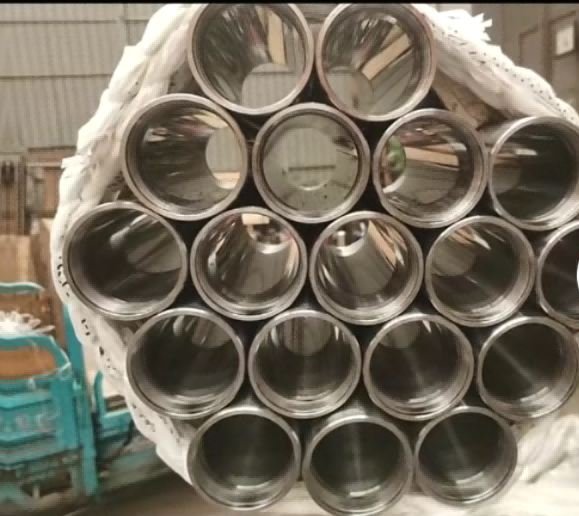
Honed tubing, honing pipe or honed pipe: the same bore, different shop wording
Honed tube is bought under several names, and the wording usually comes from the buyer’s own workshop rather than from a standard. The product is the same family; what changes is whether the drawing controls the bore, the outside diameter, or both.
| Wording | What it normally means | What to put on the drawing |
|---|---|---|
| honed tube | Cold drawn tube with the bore honed to a controlled diameter and finish | ID, ID tolerance, Ra, OD or wall, length |
| honed tubing | The same product sold by length or in bundles; common plant wording | Total length and cut length, not only the tube size |
| honing pipe / honed pipe | Shop wording for a honed cylinder barrel, often sized by bore | Nominal ID and H8/H9 tolerance, plus the pressure duty |
| honed ID tubing | The bore is the controlled surface; the OD may be left for later machining | State whether the OD is finished or only a nominal size |
| metric honed tubing | Metric bore and wall sizes, usually 15–100 mm ID for cylinder work | Metric ID, wall or OD, and length in millimetres |
| St52 honed cylinder tube | A honed cylinder tube in the St52 / E355 strength family | Name the standard and grade; St52 and E355 are comparable, not automatically interchangeable |
For a honed tube for a hydraulic cylinder, the bore is the working surface: the piston seal runs on it, so the ID tolerance, roundness and roughness decide whether the cylinder seals. The outside diameter still matters for the cylinder body, but it is a second requirement, not a substitute for the bore specification.
What honing changes
Cold drawn tube leaves a bore with longitudinal marks from the mandrel and a roughness of roughly Ra 0.8–1.6 µm. Honing removes 0.05–0.3 mm with bonded abrasive stones on a rotating and reciprocating head, producing a cross-hatch pattern.
Three properties improve at the same time:
- Diameter and roundness. Honing follows the existing bore, so it corrects ovality and taper but cannot move the bore centre. If the tube is badly eccentric, honing will not rescue it.
- Surface roughness. A properly honed bore reaches Ra 0.2–0.4 µm, which is the range most piston seals are designed for.
- Surface integrity. Honing removes the drawing marks that act as stress raisers and seal cutters, and leaves a surface that holds oil.
What honing does not do is straighten a bent tube or fix a wall that is too thin on one side. Those are decided at the drawing stage.
Honed, SRB, or as-drawn
| Condition | Material removed | Typical Ra | Characteristics | When to choose it |
|---|---|---|---|---|
| As drawn | none | 0.8–1.6 µm | Cheapest, longitudinal marks | You will machine the bore yourself |
| Honed | 0.05–0.3 mm | 0.2–0.4 µm | Cross-hatch, oil-retaining, precise roundness | Repair shops, small batches, bores corrected after welding |
| SRB (skived and roller burnished) | 0.2–0.5 mm | 0.1–0.3 µm | Work-hardened, mirror finish, no cross-hatch | High-volume cylinder production |
SRB is faster and leaves a harder surface, which is why automotive and mobile hydraulic plants use it. Honing gives better control of geometry when the tube has been welded, stress relieved, or when the bore is out of round. Both are accepted by seal manufacturers; the choice is usually made by the cylinder builder’s process, not by the seal.
Writing a specification
A honed tube specification needs six numbers. Without them, every quotation is a guess.
- Inside diameter and tolerance. H8 or H9 covers most hydraulic cylinders. State the nominal ID and the tolerance class, not just “precision bore”.
- Outside diameter or wall. The wall carries the pressure. Give OD if the cylinder has a fixed outer envelope, otherwise give the calculated wall.
- Surface roughness. Ra 0.2–0.4 µm is the normal band. Add Rz or Rmax if your seal supplier specifies it — Ra alone can hide isolated deep scratches.
- Straightness. State the limit your machining process needs. Long strokes need tighter control because the piston rod amplifies any bend.
- Length and end finish. State cut length, tolerance, and whether ends are plain, chamfered or threaded.
- Steel grade and certificate. 20#, 45#, 27SiMn, 16Mn, 25Mn, St52 or another grade agreed with the mill, with a 3.1 certificate if the cylinder is going into a regulated application.
A practical example: “Honed tube, ID 80 H8, wall 7.5 mm, 27SiMn, Ra 0.2–0.4 µm, length 1,200 mm ±1 mm, plain ends, oiled.”
That sentence is enough for any tube mill to quote and for any inspector to check.
Material selection
| Grade | Equivalent | Yield strength | Honed tube use |
|---|---|---|---|
| 20# | AISI 1020 | ≥ 245 MPa | General-purpose cylinders, agricultural machinery |
| 25Mn | AISI 1025 | ≥ 275 MPa | General machining, medium-pressure cylinders |
| 16Mn | E355 / St52-3 | ≥ 345 MPa | High-pressure cylinders, thin walls, construction equipment |
| 45# | AISI 1045 | ≥ 355 MPa | Barrels machined after welding |
| 27SiMn | — | ≥ 835 MPa | High-pressure barrels, mining and heavy equipment |
| St52 | DIN 2391 | ≥ 355 MPa | Drawings written to the older DIN grade |
The table lists the grades we supply most often. Others can be quoted against the drawing, and the certificate follows the grade actually supplied.
Grade selection is a pressure calculation, not a preference. If you know the bore, the rod diameter and the working pressure, the wall follows from the hoop stress with a safety factor. Choosing 27SiMn to save 2 mm of wall is often cheaper than choosing 20# and machining a thicker tube.
Reading a roughness specification
Ra is the arithmetic mean of the profile deviation. It is useful for comparison but it does not describe the shape of the surface. Two bores can both read Ra 0.3 µm while one has deep valleys that cut seals and the other does not.
For hydraulic service, ask for Ra together with Rz or Rmax, and state the measurement direction — along the bore, not across the cross-hatch. A honed surface typically has Rz about four to six times Ra. If a supplier quotes Ra only, ask what Rmax they hold.
Defects to reject
| Defect | What it looks like | Usual cause |
|---|---|---|
| Longitudinal scoring | Straight scratches along the bore | Contamination in the honing oil, damaged stone |
| Chatter marks | Regular ripples, often near the ends | Wrong stone pressure or spindle speed |
| Taper | ID smaller at one end | Worn stones, insufficient stroke overlap |
| Bell-mouth | Bore opens up in the first 20–30 mm | Tool entry without guide, excessive pressure |
| Embedded grit | Dark specks that catch a fingernail | Poor cleaning after honing |
| Ovality | ID differs between two axes | Tube eccentricity too large before honing |
Any of these will shorten seal life. Scoring and embedded grit are the most common reasons a cylinder fails its first pressure test.
Checking an incoming lot
You do not need a metrology lab to catch most problems:
- Measure ID with a bore gauge at both ends and mid-length, in two directions 90° apart. The difference between directions is the ovality; the difference between ends is the taper.
- Run a fingernail along the bore. Anything that catches is a defect, whatever the roughness gauge says.
- Check roughness at three positions with a portable tester, measuring along the axis.
- Roll the tube on a flat bed and measure the gap under a straight edge at mid-length.
- Look into the bore with a light at a low angle. Scoring shows up clearly under oblique light.
Record the results against the heat number. If a batch later gives trouble, the records tell you whether the tube or the machining was at fault.
What drives the price
Honed tube costs more than as-drawn tube for four reasons: the honing allowance (more material removed means a thicker starting wall), the time on the honing machine, the inspection, and the yield loss when a bore is scrapped. Long tubes and tight straightness limits cost disproportionately more because they need special handling.
If the budget is tight, the usual savings are: choose the nearest standard ID instead of a custom bore, accept H9 instead of H8, and buy in production lengths and cut in-house.
FAQ
Is a honed tube the same as a seamless tube? No. Seamless describes how the tube body was formed; honing describes the bore finish. A honed tube is usually made from a seamless cold drawn tube, but a welded cold drawn tube can also be honed.
Can a honed tube be welded? Yes, but weld the cylinder components first and hone afterwards, or protect the bore with a purge and heat sink. Welding distorts the bore near the seam, and that distortion is exactly what honing removes.
What roughness do polyurethane seals need? Most polyurethane and PTFE seal systems are specified for Ra 0.2–0.4 µm. Below 0.1 µm the surface can be too smooth to retain oil; above 0.6 µm seal wear rises quickly.
Why does a honed bore rust so fast? Honing leaves a clean, active steel surface with no oxide layer. It must be oiled immediately after machining and kept wrapped. A honed bore that is handled with bare hands will show fingerprints within days.
Can you hone a tube after chrome plating? Chrome is applied to the OD of piston rods, not to the bore. If the bore needs correction after plating, the plating has to be stripped first.
What is the maximum length? Honed length depends on the machine stroke and is confirmed for each order. Send the finished length and we will confirm what we can supply.
Is honed tubing the same as honing pipe? In most workshops, yes: both mean a tube with a honed bore. Confirm whether the drawing dimensions the bore or the outside diameter, because a pipe-sized item and a tube-sized item can be different products even when the wording is the same.
Can you supply metric honed tubing in St52? Yes. We hone cylinder tube from 15–100 mm ID in the St52 / E355 family, to the ID tolerance and Ra on the drawing. State the standard as well as the grade, since St52 and E355 are comparable but not automatically the same certificate.