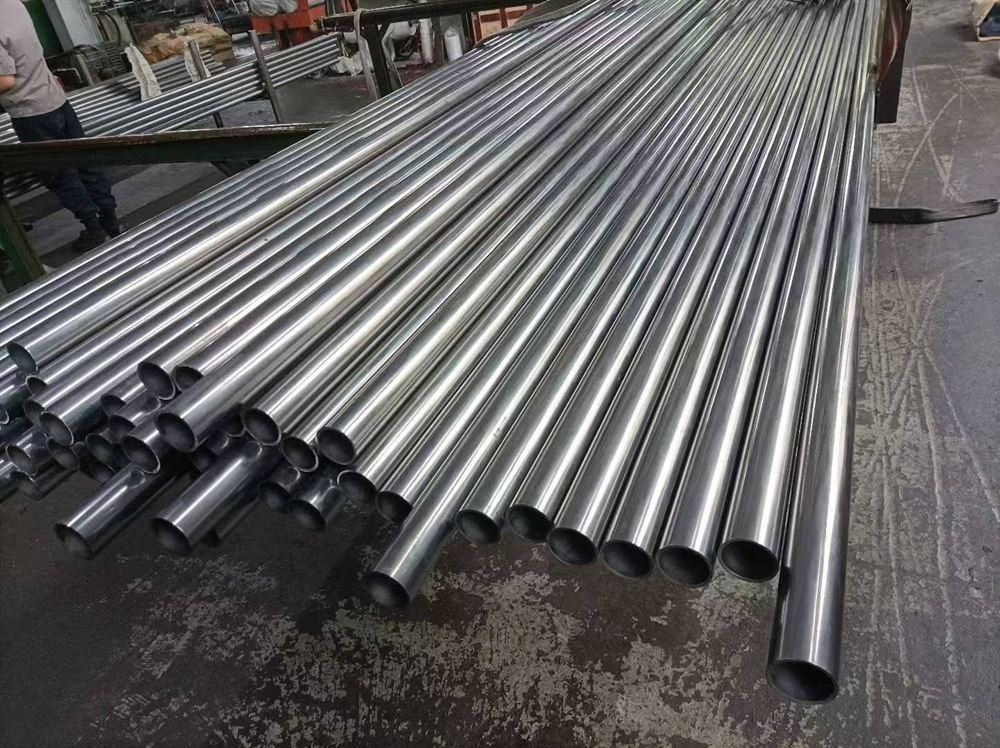
A steering system uses steel tube in three places, and each one asks for something different from the tube. We supply all three from the same mill: cold drawn seamless to EN 10305-1 and DIN 2391, cold drawn welded to EN 10305-2, and DOM tube where the inside diameter has to be clean enough to take a shaft or a bearing. Sizes run from 12 mm to 60 mm outside diameter, in grades E235, E355, 20# and 45#, cut to length.
Price: quoted per specification. Steel prices move with the raw material market, so every quotation is confirmed at the time of order.
Three tubes in one steering system
| Part | What the tube does | What is critical |
|---|---|---|
| Steering column jacket | Houses the shaft and the lock, mounts to the body | OD roundness, straightness, wall for the mounting bracket |
| Steering shaft tube | Carries torque from wheel to rack or gearbox | Torsional strength, wall concentricity, spline or weld end |
| Rack housing / gear housing tube | Holds the rack or the recirculating ball nut | Bore size and finish, wall thickness for the housing thread |
The jacket is the easy part: a straight, round tube with a good surface for painting or plating. The shaft is the part that fails if the tube is wrong, because the wall carries the torque and any eccentricity puts more stress on one side.
Why concentricity and straightness decide the part
A steering shaft is usually welded or splined at both ends and then machined. If the wall is eccentric, the machined shaft ends up with a thin side, and that is where it cracks in fatigue. Cold drawing over a mandrel keeps the wall concentric to within a small fraction of the wall thickness, which is why DOM and cold drawn seamless are preferred over plain ERW for shaft work. Straightness matters for the same reason: a tube that is 2 mm out over a metre cannot be machined true without removing a lot of material.
Grades and supply condition
| Grade | Standard | Where it is used |
|---|---|---|
| E235 | EN 10305-2 (welded), EN 10305-1 (seamless) | Column jackets, brackets, low-stress housings |
| E355 | EN 10305-1 | Shafts and housings that need more strength at the same wall |
| 20# | GB/T 3639 | Shafts on Chinese drawings, easily welded |
| 45# | GB/T 3639 | Higher torque shafts, usually machined after drawing |
Supplied as drawn, annealed for forming, or cut and deburred. If the shaft is going to be welded to a yoke, tell us: the carbon content decides the weld procedure, and 45# needs preheat where 20# does not.
Sizes we run for steering parts
| Application | OD range | Wall range | Notes |
|---|---|---|---|
| Column jacket | 25–45 mm | 1.5–2.5 mm | Straightness and OD finish are the buying points |
| Shaft tube | 16–35 mm | 1.5–3.0 mm | Concentric wall, DOM or seamless |
| Rack housing | 30–60 mm | 2.5–5.0 mm | Bore finish, thick wall for threads |
These are the ranges we draw regularly rather than a catalogue limit. If your drawing calls for something outside them, send it and we will say whether it can be drawn or has to be machined from bar.
FAQ
Seamless or DOM for a steering shaft? Both are used. DOM starts as welded tube and is drawn over a mandrel, which brings the wall concentricity close to seamless at a lower cost. For high torque or safety-critical shafts, seamless is the safer specification.
Can you supply tubes with the spline already cut? No. We supply the tube; splining and machining are done by the tier-one supplier. We can hold the OD and wall tolerance that the splining operation needs.
What lengths do you cut? Fixed lengths to your drawing, normally up to 6 m before cutting. Short cut lengths for a specific part are quoted with the deburring.
Do you supply samples before a production order? Yes, short cut samples from the production lot, so the grade and tolerance you approve are the ones you receive.