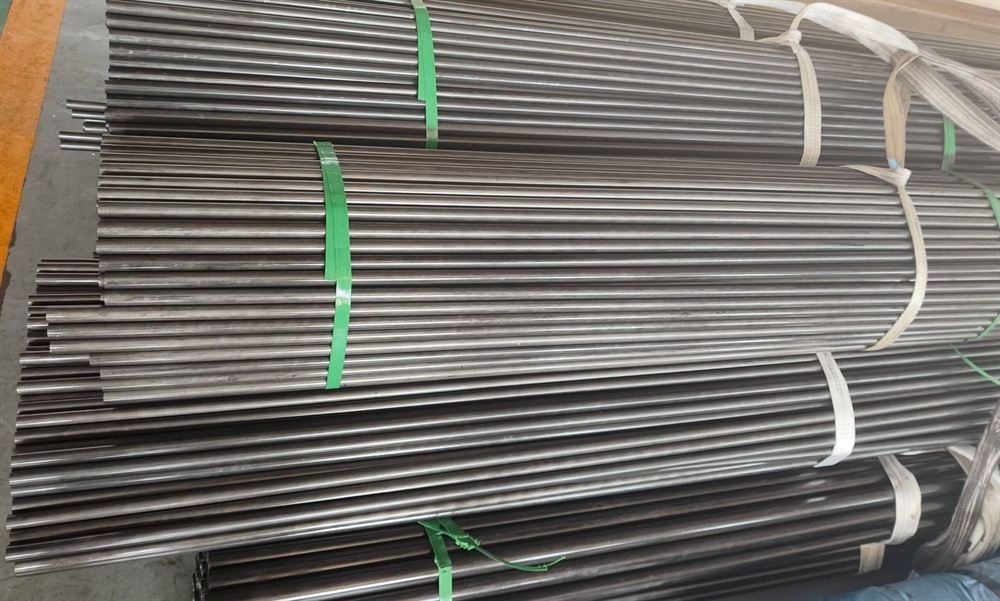
A gas spring is a sealed cylinder with a piston rod and compressed nitrogen. The tube is the pressure vessel and the running surface at the same time, so it is bought to a tighter specification than ordinary precision tube: controlled bore, low roughness, uniform wall and a clean cut end for the crimp or the weld. We supply gas spring tube cold drawn in E235 and E355 to EN 10305-1 / EN 10305-4, and cold drawn welded to EN 10305-2 in the smaller sizes, from 12 mm to 40 mm outside diameter, black phosphated or zinc plated, cut to length.
Price: quoted per specification. Steel prices move with the raw material market, so every quotation is confirmed at the time of order.
What the tube has to do inside a gas spring
- Hold pressure. The wall carries the nitrogen load. A thin or eccentric wall bulges before it bursts, and the spring loses force.
- Guide the piston. The bore is the running surface for the piston seal. Bore tolerance and roughness decide whether the spring extends smoothly or sticks.
- Seal at the ends. The tube is usually crimped, rolled or welded closed. Wall thickness and grade have to suit that forming operation, and the cut end has to be square and burr-free.
Bore tolerance and roughness
| Condition | Bore tolerance | Roughness | Used for |
|---|---|---|---|
| As drawn | H9–H10 | Ra 0.8–1.6 µm | Springs where the customer hones or roller burnishes in-house |
| Honed / roller burnished | H8–H9 | Ra 0.2–0.4 µm | Ready-to-assemble barrels |
| Outside diameter ground | — | Ra 0.4–0.8 µm | Where the tube is clamped or runs in a guide |
For most furniture and tailgate springs, an as-drawn bore with a controlled Ra is enough. For damped springs and anything that has to hold position, the bore is normally honed, because a rough bore wears the seal and the spring starts to creep.
Seamless or welded?
Small gas springs are often made from welded cold drawn tube, because the sizes are small and the pressure is moderate. Larger springs, and anything with a long service life or a high charge pressure, are usually seamless. The decision is the same as for hydraulic barrels: if the tube is a pressure vessel first, buy seamless; if it is a guide first, welded cold drawn is usually acceptable.
End forming decides the grade
Crimping and rolling need a grade that will deform without cracking, which is why E235 is the common choice. Welding the end cap needs a grade with controlled carbon, so 20# or E235 rather than 45#. If your process is a rolled thread or a swaged end, tell us at enquiry stage and we will supply annealed tube, which forms far more predictably than as-drawn.
Typical sizes
| Spring type | OD | Wall | Finish |
|---|---|---|---|
| Furniture and cabinet spring | 12–22 mm | 1.0–1.5 mm | Black phosphated |
| Automotive tailgate / bonnet strut | 18–28 mm | 1.2–2.0 mm | Black phosphated or zinc plated |
| Industrial gas spring, damping | 25–40 mm | 1.5–2.5 mm | Zinc plated |
FAQ
Do you supply the complete gas spring? No. We supply the tube, cut to length; the rod, seal, piston and charging are done by the spring maker.
Can the tube be supplied with the end already crimped? Not from us. We hold the wall and grade so that your crimping tool produces a repeatable joint, and we can supply samples for your forming trial.
Which finish is normal? Black phosphating is the standard for gas springs: it holds oil, takes paint and does not flake when the tube is deformed. Zinc plating is used where the spring is exposed and corrosion is the main concern.
How is the tube packed? Bundled and strapped, with end protection, so the bore is not damaged in transit.